Essay / EN
Stańczyk and the Paradox of the Sad Clown
An exploration of Jan Matejko's Stańczyk and the paradox of the sad clown — finding meaning in comedy, sadness, and the inability to laugh at oneself.
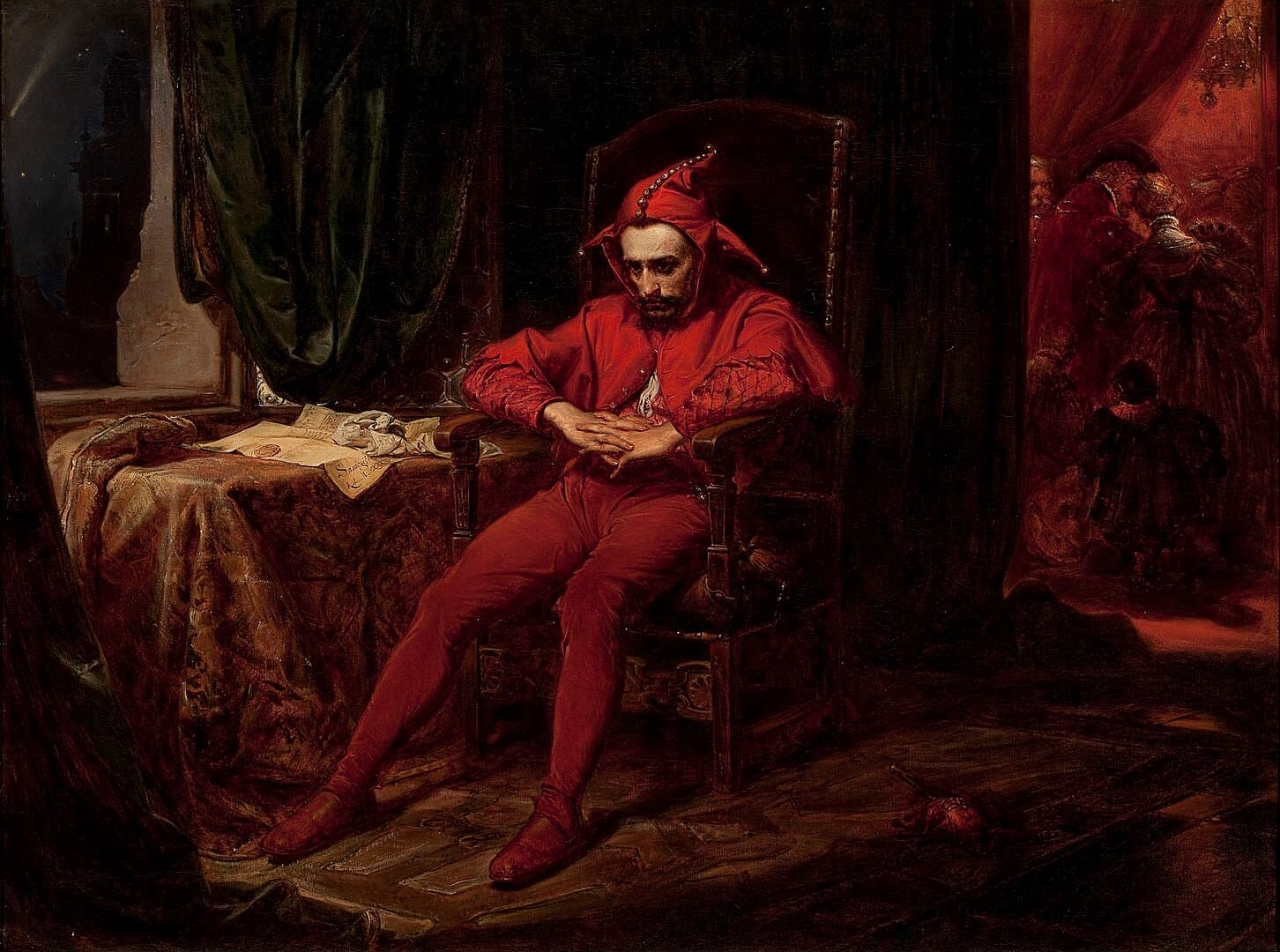
🇵🇱 Jan Matejko - Stańczyk at a dance in the court of Queen Bona after the loss of Smolensk (1862)
The paradox of the sad clown is simple to name and hard to live: the person who can produce laughter in a room may be the least able to join it.
That is why Matejko's Stańczyk has stayed with me for so long. The painting does not show a jester in motion. It shows a jester after the performance has failed to save him. He sits alone in red, folded into himself, while the court continues behind him in light and music. The carpet under his feet is disturbed. A letter lies open on the table. The lute has been dropped. Behind him, the ballroom glows with the cheerful stupidity of people who do not yet understand what has been lost. Stańczyk, whose work is to keep the court amused, is the only person in the room unable to participate in its mood.
He has seen something the others have not.
That is the paradox. The clown is licensed to interrupt seriousness for everyone else, but he is rarely granted seriousness for himself. His suffering is either invisible or converted into performance. If he speaks, people laugh. If he falls, people laugh harder. If he says something true, the room may only accept it if the truth arrives wearing bells.
I think that is why I have always felt close to this painting, though "close" may not be the right word. It would be more accurate to say that I recognized the structure immediately. The room behind him. The private collapse in the foreground. The fact that other people's laughter can sometimes deepen rather than relieve your solitude.
The News in the Room
Historically, the painting is tied to the loss of Smolensk, though Matejko compresses time in the way great historical painters often do when they are trying to paint not an event but a national mood. Whether every detail is historically exact matters less to me than the psychological truth of the composition. Stańczyk is not simply sad because a city has fallen. He is sad because he knows the fall matters and the people around him are still dancing.
That is what the painting captures so mercilessly: not sorrow in isolation, but sorrow intensified by the indifference of the room.
Stańczyk's face is not melodramatic. It is tired. His hands are not theatrical. They hang with the heaviness of someone who has stopped trying to translate what he knows into language other people can bear. The red of his clothing should make him the brightest thing in the room, and yet it feels like a wound. Even the open window in the background does not promise escape. It only reminds you that the world goes on while he sits there, unable to synchronize himself with it.
I know that posture. I have sat in it more than once.
Falling at the Party
When I was a child, I went with my mother to Peñón Blanco, where she was teaching some kind of class. There was a party afterward, and like many children who do not yet understand how rooms work, I wanted very badly to make a good impression. I wanted to participate. I wanted to be liked. I wanted, in the desperate and embarrassing way children want it, to become instantly legible to the other children around me.
Instead I slipped and fell.
I was wearing orthopedic shoes then, and they were slippery enough to betray me at exactly the wrong moment. I remember the shock less than I remember the laughter. Everyone laughed. Not with cruelty exactly — children do not need cruelty for laughter; they only need an event. But I felt the shame so intensely that I ran out crying. I went toward the edge of the woods because I could not bear the room anymore. My mother came after me, angry at first, then worried, and I remember standing there in the stupid magnificence of childhood humiliation believing that I would never return.
What I did not know yet was that embarrassment has a strange power. Once I came back, the very thing that had expelled me from the room made me visible inside it. The children wanted to play with me. My fall had turned me, however briefly, into a figure of interest, even warmth. I had become funny against my will.
That is one of the earliest things I remember learning about social life: shame can be converted into charm by everyone except the person who feels it.
Cutting My Hair in Belgium
Years later, in Belgium, I had an anxiety attack severe enough that I started cutting my own hair. Not trimming it. Attacking it. I kept telling myself I could fix it with one more cut, one more adjustment, one more correction, until I looked like someone who had lost a fight with a lawnmower and then tried to tell a coherent story about it.
When my roommates and friends saw me, they laughed. I laughed too, eventually. By the next day I had already begun turning the haircut into material. I told different people different versions: I lost a bet, I let a blind friend cut it, I had watched a football match and pulled it out in frustration, I had gotten a free haircut from someone in training and didn't want to be rude. None of it was true. All of it worked. People laughed. I laughed with them. I performed my own disaster so well that, for a few hours, I forgot the misery that had produced it.
That is the sad clown's bargain. If you can narrate your own collapse quickly enough, stylishly enough, before anyone else gets there first, then maybe you can survive it. The humiliation remains yours, but the room receives it as entertainment rather than threat.
The performance helps. It just does not heal.
Why the Clown Cannot Save Himself
What fascinates me about Stańczyk is that Matejko does not paint him as someone who lacks social power. On the contrary, the jester is central to the court. He sees everyone. He can say things others cannot. His nearness to power is part of what makes his sadness so devastating. He is not excluded from the feast. He is included under terms that prevent real belonging.
That, I think, is the heart of the paradox. The clown is useful to the room because he can metabolize tension. He can convert awkwardness into laughter, fear into wit, disaster into anecdote. But the room has no corresponding mechanism for metabolizing the clown's actual pain. The very role that gives him access also traps him. The more skillfully he performs lightness, the less imaginable his heaviness becomes to others.
I have often felt that split in myself. I enjoy making people laugh. I enjoy absurdity, mimicry, well-placed lies in the service of relief. Under pressure, I become more verbal, not less. But there are forms of sadness that performance cannot touch. Or rather, performance can touch them only by circling them, disguising them, turning them into a shape the room can tolerate. The joke lands. The wound remains.
That is why Stańczyk is painted seated, not standing. The performance has stopped. There is no one to entertain in the foreground. There is only the body after usefulness. The room is behind him now, and he is no longer facing it. He has withdrawn just enough to become visible to himself.
The Mirror Stage of Misery
I do not want to force theory onto the painting like a costume it did not ask to wear. But I will say this: when I think about Lacan's mirror stage, I do not think only of infancy or psychic formation. I also think of those adult moments when the image you present to others cracks and you suddenly have to confront the gap between the performed self and the suffering one.
That gap is where Stańczyk sits.
He is the public self in retreat from itself. The clown who can no longer believe in his own function. The man whose value to others has been built on his ability to turn tension into laughter, and who has now encountered something that will not convert. The loss of Smolensk in the painting is historical, but the feeling is intimate: everyone else is dancing, and you have just received news that makes the dance impossible.
I think many people know this feeling even if they do not live it through comedy. You can be the calm one in your family, the smart one in your friend group, the funny one at work, the person who keeps rooms from collapsing into awkwardness. And then, one day, the room asks that version of you to keep functioning while something in you has already gone still.
That is when the costume starts to feel heavy.
The Gift and the Cost
I do not want to end by saying that sadness is secretly a gift. That is a sentimental lie and sadness deserves better than sentimentality. But I do think there is a kind of sight that belongs to the people who cannot fully merge with the room. Stańczyk sees the celebration differently because he is not dissolved in it. He is capable of distance, and distance is often painful, but it is also clarifying.
The clown sees where the laughter becomes defense. He sees where celebration becomes denial. He sees where people amuse themselves in order not to look directly at what is happening.
Maybe that is why I keep returning to paintings like this one. They do not flatter joy. They do not tell us that performance and feeling are the same thing. They insist on the split. They insist that a person can be central and lonely at once, visible and unread at once, funny and unwell at once.
Stańczyk sits with his back to the party because the party cannot help him. That is the tragic part. But it is also, perhaps, the honest part. He is no longer pretending that participation and belonging are identical.
I know something about that too.
And maybe that is why the painting feels less like an object of study than a mirror placed at a painful angle: it shows the moment when laughter stops being an escape and becomes evidence. Evidence that the room was never the same place for you as it was for everyone else.
🇬🇧 Thank you for reading
Keep reading